- View Contact Information
-
- Steven Nutter
Director of Sustainability and Environment
snutter@somervillema.gov
Cell: 781-823-9435
617-625-6600 ext. 2422 - Emily Sullivan
Climate Change Program Manager
esullivan@somervillema.gov
Cell: 781-823-9248
617-625-6600 ext. 2426 - Elyse Belarge
Sustainability & Resiliency Planner
ebelarge@somervillema.gov
Cell: 781-823-9332
617-625-6600 ext. 2427 - Naomi Gross
Community Engagement Specialist
ngross@somervillema.gov
Cell: 857-274-2463
617-625-6600 ext. 2425 - Josh Eckart-Lee
Sustainability Planner
jeckartlee@somervillema.gov
Cell: 857-270-4996
617-625-6600 ext. 2421 - Kathy Cole
Financial Analyst
kcole@somervillema.gov
617-625-6600 ext. 2428 - Garrett Anderson
Energy Manager
ganderson@somervillema.gov
Cell: 857-270-4403
617-625-6600 ext. 2429 - Kate Bossingham
Environmental Policy Manager
kbossingham@somervillema.gov
Cell: 857-270-4608
617-625-6600- ext. 5070 - Shannon Taylor
Energy Advisor
staylor@somervillema.gov
Cell: 857-270-4965
617-625-6600 ext. 2424
The OSE team works remotely from time to time, so please call their cell phones if you are unable to reach them at their office extensions.
Hours
Monday - Wednesday
8:30 a.m. - 4:30 p.m.Thursday
8:30 a.m. - 7:30 p.m.Friday
8:30 a.m. - 12:30 p.m.Email
Address
City Hall Annex
50 Evergreen Ave.
Somerville, MA 02145 - Steven Nutter
Buildings and Energy
We spend 90% of our time indoors according to the Environmental Protection Agency. So, it makes sense that we want the spaces we live and work in to be healthy and safe. Same goes for the energy that we use to power our infrastructure and our everyday lives; it should be affordable, efficient, and sustainable.
Buildings & Energy is a key focus area in Somerville’s Climate Forward Plan. The Plan lays out the actions our community will take to ensure that 100% of Somerville’s electricity is from renewable sources and that our buildings and homes are built and retrofitted to be net-zero carbon, healthy, resilient, and affordable.
Jump To:
Greenhouse Gas Emissions
Buildings are energy intensive and account for the largest portion of energy use. Our lights, appliances, air conditioning systems, and heating systems all consume energy.
This means that buildings also produce a significant amount of greenhouse gas (GHG) emission, the primary pollution causing climate change. In Somerville, 63% of GHG emissions come from buildings: 49% from residential buildings, 41% from commercial buildings, and 10% from natural gas leaks.
Image

Source: City of Somerville GHG Inventory (Prepared by AECOM)
The Fuels We Use
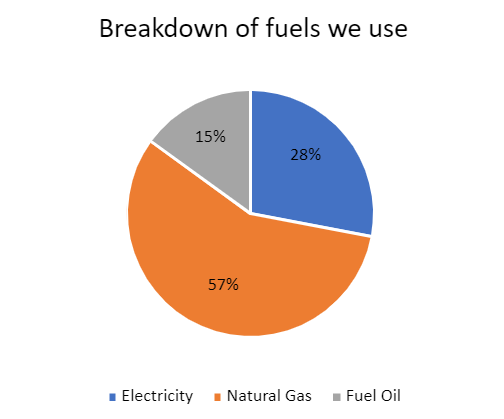
So, now you know where buildings emissions are coming from. But what about the fossil fuels that are burned to create them? Take a look at the pie chart and you'll see that natural gas is the dominant fuel Somerville uses to heat, cool, and power its buildings. As we work towards our goal of net-zero emissions, we'll aim to power more and more of our buildings with clean electricity and renewable energy instead of natural gas.
Image
Renewable Energy
Community Choice Electricity
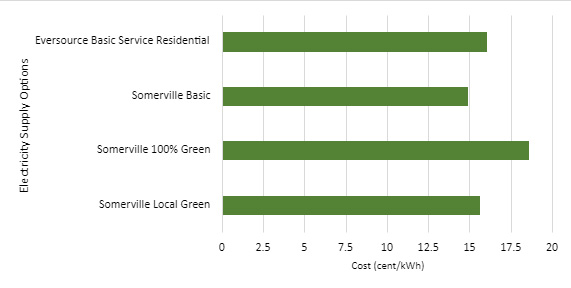
56% of Somerville residents participate in the Community Choice Electricity (CCE) Local Green option. The CCE program provides new electricity supply options and more renewable energy to Somerville residents and businesses.
Fun fact: Since 2017, Somerville CCE’s default product has saved participants over $22 million in savings, compared to Eversource Basic Service, while also containing more renewable energy. Future savings cannot be guaranteed.
|
Image
|
|
Source: Somerville CCE Products
|
What is a Kilowatt hour (kWh)?
A measure of electricity equal to 1,000 watts of power expended for 1 hour. One kWh is about equivalent to running an average dishwasher for an hour.
Energy Efficiency
Energy efficiency is all about using less energy while providing consistent, reliable power and reducing waste. An energy efficient building can maintain an ideal temperature while using the least amount of energy possible to do it.
There are many ways to reduce the amount of energy our homes and businesses consume while improving resilience to climate impacts. For example, the Somerville Energy Efficiency Now (SEEN) program provides energy efficiency and heat pump advisory services. The Climate Forward Plan lays out several priority actions to help us reduce emissions:
Image
- Making sure new buildings meet certain standards to withstand flooding and extreme heat.
- Adopting flood and extreme heat resilience standards for new construction.
- Requiring rental properties to report their energy use.
- Expanding programs to electrify building heating and cooling systems (HeatSmart/CoolSmart).
Networked Geothermal
The City’s Office of Sustainability and Environment (OSE) went through a competitive procurement process and selected engineering and design firm Buro Happold to help assess the feasibility of networked geothermal in Somerville. As part of this feasibility assessment Buro Happold has identified three neighborhoods to study the potential to install a system. Networked Geothermal is an emerging utility-scale technology that can help communities transition to efficient renewable energy by using the stable temperatures of the bedrock beneath the earth’s surface.
In networked geothermal systems, geothermal wells and ground source heat pumps are linked together to serve a collection of connected buildings, including residential and businesses, on a neighborhood scale. The technology can help Somerville reach its greenhouse gas reduction goals by providing a cleaner and safer alternative to fossil fuels.
This work is made possible through a Kickstart Mass grant from the Massachusetts Clean Energy Center (MassCEC) and HEET, which was awarded to help Massachusetts communities that have displayed interest in implementing geothermal networks begin to study the feasibility of the technology. To read the final HEET Kickstart Report here.
Read the feasibility report here to learn what will it take to electrify buildings, Somerville's largest source of greenhouse gas emissions. This first of its kind report dives into the issue of transformer upgrades and offers solutions, including exploring the connection to geothermal networked systems.
Helpful links:
- Learn about ways the City of Somerville can help you save energy and reduce your carbon footprint now.
- Read more about the City of Somerville's Networked Geothermal Initiative
- Watch a video recording of an educational presentation and community meeting about Networked Geothermal held on December 9th, 2024
- See the presentation slides from the community meeting held on December 9, 2024
- Watch a video recording of the Draft Feasibility Study Report Webinar from March 25th, 2025
- If you are having an issue with a transformer upgrade please fill out this form
- If you are interested in networked geothermal please fill out this form.
Proposed Rental Registry Ordinance
What would the ordinance do? The ordinance would provide basic information to renters and the public about the rental units in the city, improve city communications to rental unit owners and city functions, and inform city policy and programs.
What would happen if the ordinance is passed? If the ordinance is passed by the City Council, city administration will convene a working group of interdepartmental representatives to write the program manual.
The program manual would be directly informed by community and stakeholder input. It would define programmatic processes and procedures to comply with the ordinance. The working group would meet regularly over a period of time to develop the manual and may solicit additional input from the community and stakeholders about the specific program processes and procedures as they are drafted.
City administration will conduct communitywide outreach to rental unit owners and the public to inform them of the program and provide assistance and education. Regular public communication and feedback will be a cornerstone of the ordinance program development, with a goal of all rental building owners will be able to efficiently fulfill the ordinance disclosure requirements and high-quality information will be available for property owners, prospective renters, and the public as applicable.
Helpful links:
- Read a short summary about the ordinance
- Read the results of stakeholder interviews and focus groups about the proposed ordinance conducted in the Summer and Fall of 2024
- Read a draft of the proposed ordinance
- Learn more about the vision for the Rental Registry and the focus group outreach here
- See the November 20, 2024 Rental Registry Community Meeting presentation slides or watch the meeting recording
Reach out to Garrett Anderson at ganderson@somervillema.gov to learn more or with questions about the proposed ordinance.
Watch a video describing the proposed ordinance and its benefits for tenants and building owners.
What You Can Do
Make Your Home More Energy Efficient
Image

- Sign up for the Community Choice Electricity (CCE) Program
- Take advantage of Mass Save’s Energy Saving Tips to save money and reduce your emissions
- Use the Somerville Energy Efficiency Now (SEEN) Resources to learn about energy saving programs for renters and homeowners
- Explore your options for rooftop solar
- Electrify your home with heat pump rebates from Mass Save
Check out SustainaVille, the home of Somerville’s climate action initiatives.
Feedback
Please submit website feedback using this form. Be sure to include:
A description of the issue (if any)
A link to the affected pages
Thank you for your feedback!